
RVForge — one canonical RVF to signed platform installers.
forge turns a single .rvf agent into installable packages for Windows,
macOS, Linux, and RVM, without the agent inside each package ever differing.
The RVF identity, contents, policies, and signatures are the same in the
.dmg as in the .msi.
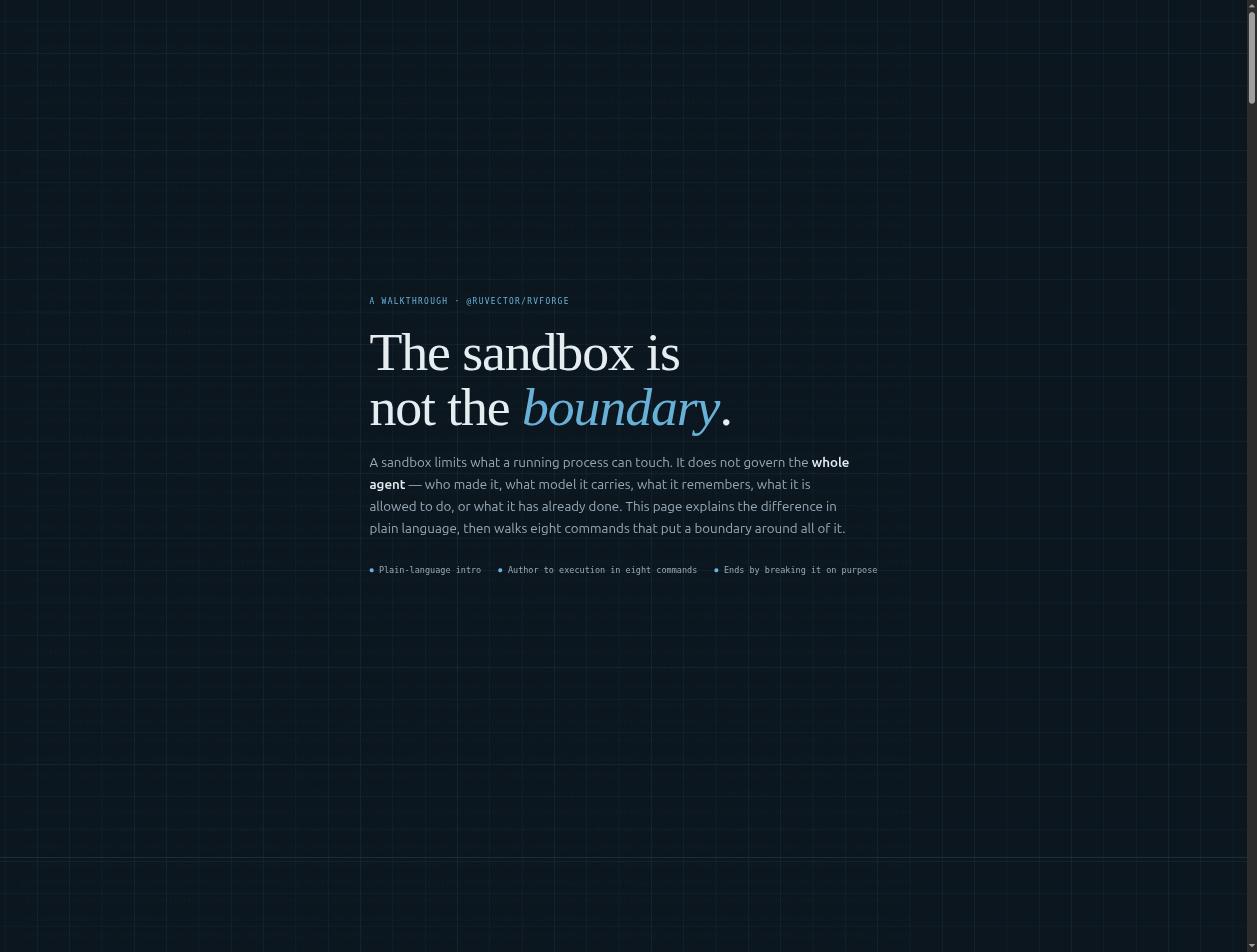
The Sandbox Is Not the Boundary →
An illustrated walkthrough at https://ruvnet.github.io/RuVector/rvforge/. It explains in plain language why process isolation does not bound an agent, then goes command by command from authoring a signed artifact to running it under the capability gate — ending by flipping one byte to show what the identity check is actually for.
See ADR-283
for the design and docs/research/rvf-forge/requirements.md for the full
requirements.
Requires Node.js 20 or later.
From an empty directory to a staged build, with nothing else installed:
npx @ruvector/rvforge init --keygen        # forge.config.json, rvforge.json, a publisher key
npx @ruvector/rvforge create               # writes a signed agent.rvf
npx @ruvector/rvforge validate agent.rvf --deep
npx @ruvector/rvforge test agent.rvf
npx @ruvector/rvforge build --mode embedded
npx @ruvector/rvforge verify forge-out
create is what makes the rest runnable: every other command reads an .rvf,
and until you have one there is nothing to validate, pack, or build.
npx @ruvector/rvforge init                     # scaffold forge.config.json
npx @ruvector/rvforge init --keygen            # …plus rvforge.json and a publisher key
npx @ruvector/rvforge create                   # write a signed agent.rvf
npx @ruvector/rvforge validate agent.rvf       # structural check, no execution
npx @ruvector/rvforge build agent.rvf          # local build (--mode embedded|thin)
npx @ruvector/rvforge submit agent.rvf --yes   # hosted build
npx @ruvector/rvforge status BUILD_ID
npx @ruvector/rvforge download BUILD_ID
npx @ruvector/rvforge verify AgentSetup.exe
The publisher verbs work against rvforge.json and a registry rather than
against installers:
npx @ruvector/rvforge pack agent.rvf           # the ADR-294 validation list
npx @ruvector/rvforge test agent.rvf           # inspection-only test categories
npx @ruvector/rvforge publish agent.rvf        # sign and append a release
Targets are windows-x64, windows-arm64, macos-x64, macos-arm64,
macos-universal, linux-x64, linux-arm64, and rvm, with windows,
macos, and linux accepted as aliases. Pass them after the .rvf:
npx @ruvector/rvforge build agent.rvf windows macos linuxOmit the .rvf and forge uses rvf from the config; omit the targets and it
uses targets.
Writes a valid, signed .rvf. It reads the project metadata and declared
capabilities from rvforge.json and signs with the key init --keygen
recorded there, so the common case takes no arguments:
forge create                       # -> agent.rvf, signed
forge create build/my-agent.rvf    # explicit output path
forge create --from ./payload      # include real payload files as segments
forge create --unsigned            # development build, no signature
forge create --force               # overwrite an existing output file
With no --from, the output is a minimal but complete agent skeleton: a META
segment declaring the capability classes the project requests, and a signed
root MANIFEST. That is enough for validate, test, pack, publish, and
build to run, which is the point — you can walk the whole pipeline before you
have a model to put in it.
--from <dir> adds every file under the directory as a segment, visited in
sorted order. A .wasm file becomes an executable WASM segment and is signed
individually; anything else becomes an opaque VEC payload segment. Payload
bytes are read, hashed, and stored — never parsed as code, linked, or executed.
Refuses to overwrite. An existing output file is an error (FORGE_E_IO)
unless --force is passed, so a second create cannot silently discard the
artifact you already signed and published.
Signing. --key-file overrides the path in rvforge.json. Without either,
create fails with FORGE_E_KEY rather than quietly writing something
unsigned; pass --unsigned when that is what you actually want. Only the key
id is ever printed. An unsigned container carrying an executable segment is
refused by validate unless you also pass --allow-unsigned.
Deterministic. The same project, key, and inputs produce byte-identical output. Timestamps are zero, segment ids come from position, payload files are sorted, and the file id is derived from the project's name, version, and publisher — so rebuilding an agent reproduces its identity rather than minting a new one.
The container create writes is the format crates/rvf-forge-core reads;
scripts/rvforge-parity-check.sh proves it by having the Rust crate inspect
and verify a container this command produced, signatures included.
Checks that the file is a well-formed RVF: root-manifest magic and CRC32C, manifest field consistency, a segment-header walk, and signature presence. It reads bytes and never executes, links, or interprets RVF content.
The default pass touches one 4 KiB page plus one 64-byte header per segment,
which keeps it under two seconds for RVFs below 1 GB. --deep additionally
streams the whole file through SHA256 to compute the canonical RVF identity.
forge validate agent.rvf --deep
forge validate agent.rvf --allow-unsigned   # development builds only
An RVF carrying executable segments (kernel, eBPF, WASM) with no root-manifest
signature fails with FORGE_E_UNSIGNED_SEGMENT unless --allow-unsigned is
passed.
Produces the canonical build manifest, one staged bundle per target, a software inventory, SHA256 checksums, a provenance record, and a witness receipt:
forge-out/
├── build-manifest.json                canonical, deterministic
├── inventory.json                     software inventory + bundle layout
├── provenance.json                    what was built, from what, by whom
├── checksums.txt                      sha256sum-compatible
├── receipts.jsonl                     witness chain, append-only
└── bundles/
    └── <target>/
        ├── rvf/agent.rvf              embedded payload…
        ├── rvf/locator.json           …or the signed locator, in thin mode
        └── reader/reader-slot.json    where the RVF Reader goes
The manifest is deterministic: keys, targets, and capability grants are sorted,
and nothing time-, path-, or host-dependent appears in it. The same logical
build description always serialises to the same bytes and the same
manifestSha256. Everything that varies per run lives in the provenance record.
Installer generation requires the Tauri packaging layer. Until that lands the
result is labelled staged and forge does not claim to have produced an
installer. A failed build leaves no output directory at all, rather than a
half-written one.
--mode selects how the RVF reaches each bundle, overriding
packaging.mode in the config for one build:
forge build agent.rvf --mode embedded    # the bundle carries the whole RVF
forge build agent.rvf --mode thin        # the bundle carries a signed locator
Embedded (FR001) stages the complete RVF into every target's bundle, so the
package runs with no network access. The same bytes go into every bundle — that
is core invariant 1, the embedded RVF hash must be identical across every
platform package — and forge does not take the copy on trust: it re-hashes each
staged copy and fails the build with FORGE_E_VERIFY_FAILED if any of them
diverges, rather than shipping platform packages that disagree about what the
agent is.
Thin (FR002) stages a signed RVF locator instead of the payload: the
distribution URL, the RVF identity and size, the capability-policy hash, and a
signature slot. The reader resolves the locator, checks the digest it names,
and verifies before executing. packaging.distributionUrl is required — a thin
package with nowhere to fetch from is rejected at manifest generation.
The reader slot in each bundle is a JSON descriptor, never an executable. Nothing in a staged bundle is runnable.
Forge refuses any packaging-mode / target / runtime-profile combination absent from the published RVM compatibility matrix (ADR-291 §2), before the RVF is read and before anything is uploaded:
$ forge build agent.rvf rvm
error: mode=embedded target=rvm runtime=wasm is absent from the RVM compatibility
       matrix — runtime profile "wasm" has no platform entry for target "rvm"
       (os "rvm", arch x64). Closest supported combination: mode=embedded
       target=linux-arm64 runtime=wasm.
code:  FORGE_E_UNSUPPORTED_TARGET
Forge never approximates, downgrades, or substitutes a runtime to make an
unsupported request succeed; it names the nearest supported combination and
lets you decide. The matrix is hash-addressed, and both provenance.json and
inventory.json record the revision that admitted the build, so a past
admission decision can be reconstructed.
src/compatibility-matrix.json is vendored. The canonical copy is
docs/research/rvf-forge/compatibility-matrix.json — change it there and
re-copy; tests/compat.test.ts fails when the two diverge.
Every build and every verification appends a receipt to receipts.jsonl,
following the registry data model. A receipt's id is the SHA256 of its canonical
JSON (excluding receiptId and signatures), and receipts hash-chain per
subject through prevReceipt:
{"schemaVersion":1,"type":"witness-receipt","receiptId":"sha256:…","subject":"sha256:…",
 "event":"build","outcome":"pass","actor":{"kind":"builder","id":"@ruvector/rvforge@0.1.0"},
 "evidence":{…},"timestamp":"2026-08-03T00:00:00.000Z","prevReceipt":null,"signatures":[]}
verify checks the chain before it appends to it: an edited receipt fails
because its recomputed id no longer matches, and a removed or reordered one
fails because the link no longer resolves. Either way the result is
FORGE_E_VERIFY_FAILED, and forge does not append onto a chain it just refused.
signatures is always empty on output — forge holds signing references, never
key material, so the array is a slot for a signing worker to fill.
receipts.jsonl is deliberately absent from provenance.json: it is
append-only and grows on every verification, so recording its digest would make
a build's own provenance fail the moment the chain was extended.
Recomputes every digest in a provenance record, re-derives the manifest hash from the manifest's own bytes, and checks the witness chain:
forge verify forge-out                                  # a whole build directory
forge verify forge-out/bundles/linux-x64/rvf/agent.rvf  # one artifact
forge verify Agent.dmg --provenance path/to/provenance.json
Re-deriving the manifest hash from content is what makes the check meaningful: rewriting the manifest and patching its recorded digest still fails.
submit, status, and download talk to the hosted build service. The
service is not deployed yet, so these currently fail with FORGE_E_NETWORK
against a live endpoint; the request and response shapes are the contract it
will be built to.
export FORGE_API_URL=https://forge.example
export FORGE_API_TOKEN=...        # never pass a token as a flag
forge submit agent.rvf --yes
submit validates locally, builds the manifest, and prints the estimated build
time, output size, and cost before anything is uploaded. The upload itself
requires --yes, so an unattended run cannot ship a confidential RVF to a
remote worker by accident. Downloads are hashed on arrival and discarded on a
digest mismatch.
Every command accepts --json and writes a single envelope to stdout:
{"ok": true, "command": "validate", "data": { }, "exitCode": 0}
{"ok": false, "command": "verify", "error": {"code": "FORGE_E_VERIFY_FAILED", "message": "..."}, "exitCode": 9}
Exit codes are stable:
| Code | Exit | Meaning |
|---|---|---|
FORGE_E_USAGE |
2 | Bad arguments |
FORGE_E_INVALID_RVF |
3 | Missing, truncated, bad magic, failed checksum |
FORGE_E_UNSIGNED_SEGMENT |
4 | Executable segment with no signature |
FORGE_E_UNSUPPORTED_TARGET |
5 | Target outside the supported matrix |
FORGE_E_MANIFEST |
6 | Malformed or inconsistent build manifest |
FORGE_E_NETWORK |
7 | Build service unreachable |
FORGE_E_AUTH |
8 | Credentials missing or rejected |
FORGE_E_VERIFY_FAILED |
9 | A recomputed digest diverged |
FORGE_E_IO |
10 | Filesystem failure |
FORGE_E_NOT_FOUND |
11 | Unknown build, artifact, or record |
FORGE_E_CONFIG |
12 | Bad forge.config.json |
FORGE_E_TOOLCHAIN |
13 | Required local build tool unavailable |
FORGE_E_POLICY |
14 | Capability policy absent, vague, or contradictory |
FORGE_E_LICENSE |
15 | No license declared, or one forge cannot reconcile |
FORGE_E_KEY |
16 | Signing key missing, unusable, or over-permissioned |
FORGE_E_REGISTRY |
17 | Registry directory unreadable or inconsistent |
FORGE_E_LINEAGE |
18 | Predecessor chain does not resolve |
FORGE_E_INTERNAL |
20 | A bug in forge |
forge init writes a default-deny policy: every capability class is present
and every allowlist is empty. Grants have to be added explicitly.
{
  "capabilityPolicy": {
    "defaultDeny": true,
    "allow": {
      "network": ["https://api.example.com"],
      "filesystem": ["~/Documents/reports"],
      "devices": [], "memory": [], "models": [], "state": [], "tools": []
    }
  }
}
The policy is hashed into capabilityPolicyHash and embedded in every package,
so a reviewer can confirm the permissions an installer ships with match the
ones they approved. defaultDeny is forced to true; a policy that opts out
is rejected rather than silently accepted.
pack, test, and publish implement the ADR-294 §4 publisher CLI. They read
rvforge.json — the marketplace project file, scaffolded by
rvforge init --keygen — which holds the listing metadata, publisher identity,
license, runtime requirements, and the capability contract the install UX
renders. It is separate from forge.config.json on purpose: a build is
reproducible from the build config alone, and nothing in the project file can
change a build's output. Neither file ever holds credentials.
All three take an .rvf that rvforge create wrote:
rvforge init --keygen && rvforge create && rvforge pack agent.rvfRuns every item on the ADR-294 validation list that is decidable locally — RVF
structure, publisher signature, executable segments, model provenance,
capability policy, runtime compatibility against the vendored matrix, memory
requirements, external services, software inventory, and license — then emits an
unsigned CapabilityManifest and a draft Release in the registry data model's
shapes.
rvforge pack agent.rvf --project rvforge.jsonEvery check runs before the aggregate decides, so a publisher sees all their
problems at once rather than one release at a time. A vague capability scope
— all-files, *, unrestricted — is not a failure: ADR-294 §8 makes it
require human review, so it is recorded in manualReviewTriggers, drops the
security profile to review-required, and the pack still succeeds. Treating it
as a failure would push publishers toward describing capabilities less precisely
to dodge the flag. A missing license, an undeclared memory ceiling, a class both
requested and denied, or a runtime absent from the matrix do fail, with
FORGE_E_LICENSE, FORGE_E_MANIFEST, FORGE_E_POLICY, and
FORGE_E_UNSUPPORTED_TARGET respectively.
Six of the ten P4 test categories are decidable by inspection; four are not.
| Category | Outcome |
|---|---|
| Malformed inputs | run — truncated and bit-flipped variants must be rejected cleanly |
| Capability denials | run — all fifteen ADR-286 classes must be requested or denied |
| Filesystem escape attempts | run in reduced form — declared scopes checked for traversal and root escapes |
| State checkpoint and recovery | run — contract fields present |
| Update and rollback | run — version ordering and rollback-safety declared coherently |
| Witness verification | run when a receipts.jsonl exists, otherwise skipped with the reason |
| Clean installation | skipped: requires quarantined runtime (Reader/RVM) |
| Deterministic evaluations | skipped: requires quarantined runtime (Reader/RVM) |
| Network monitoring | skipped: requires quarantined runtime (Reader/RVM) |
| Resource exhaustion | skipped: requires quarantined runtime (Reader/RVM) |
The four skipped categories are never reported as passing. Forge does not
execute an RVF, so it has no evidence about them, and ADR-294 §7 makes a trust
level a statement about evidence actually gathered. filesystem-escape says in
its own detail line that runtime probing was not attempted, so a pass there
cannot be read as the stronger claim.
test exits 9 (FORGE_E_VERIFY_FAILED) when a category fails, after printing
the full per-category report.
Targets a local registry directory implementing the storage layout in
docs/research/rvf-forge/registry-model.md.
rvforge publish agent.rvf --registry ~/.rvforge/registry --key-file publisher.keyIt writes the capability manifest, release, software inventory, and pack
provenance to objects/sha256/<2-hex>/<digest>.json; signs the release with an
Ed25519 key over its releaseId; appends to
packages/<publisher>/<name>/releases.jsonl with the predecessor resolved from
the current head; extends log/entries.jsonl and log/tree-head.json; and
chains a WitnessReceipt for the publish. Then it prints the P4 summary block.
An object's id is sha256:<hex> over its canonical JSON excluding
signatures and its own id field, so adding a countersignature later does not
change what it identifies.
Key handling. rvforge init --keygen writes the key with mode 600 and
never overwrites an existing one. publish refuses a key file any account other
than its owner can read (POSIX only — Windows has no comparable mode bits, and
the check is skipped rather than faked), and refuses a key the publisher record
does not already list: key rotation is a registry operation, not a side effect of
publishing. Key material is read only by src/keys.ts and never reaches a log
line, an error message, or a registry object.
Deviations from registry-model.md, for the parity test against
crates/rvforge-registry to reconcile:
- the tree head is a hash chain, not a Merkle tree, so it is tamper-evident but yields no per-entry inclusion proof;
- the tree head is unsigned — signing it is the registry's act, and a local registry has only the publisher's key;
packages/<publisher>/publisher.jsonandreceipts.jsonlare additions; the documented layout names neither, and the model gives no way to resolve apublisherIdback to its record;publishis added to the witness event vocabulary, which the model's list does not cover.
- RVF content is never executed. Validation, packaging, and scanning are inspection-only operations. Embedded mode copies bytes, thin mode writes a locator, and the reader slot is a descriptor rather than a binary — nothing in a staged bundle is runnable.
- The build path makes no network calls. A locator records where an RVF will be fetched from; forge does not fetch it.
- Signing references only, for platform installers. Forge records which key to ask for and which service holds it. Platform-signing key material is never read, stored, logged, or transmitted; signing happens on a worker with HSM or KMS access.
- The publisher key is the one exception, and it is contained.
publishneeds an Ed25519 private key to sign a release. It is read only bysrc/keys.ts, held as aKeyObjectrather than bytes, refused when its file is readable beyond its owner, and never returned, printed, or written into a registry object — only its derivedkeyIdand public half are. - Credentials come from the environment.
FORGE_API_TOKENis never accepted as a flag, so it stays out of shell history and process listings. - Messages are redacted. Bearer tokens, URL userinfo, and long opaque strings are stripped from error messages and detail bags before they are printed.
import {
  assertCompatible,
  buildManifest,
  readReceipts,
  runVerify,
  validateRvf,
  verifyReceiptChain,
} from '@ruvector/rvforge';

assertCompatible({ mode: 'embedded', targets: ['linux-x64'], runtimeProfile: 'wasm' });

const result = await validateRvf('agent.rvf', { deep: true });
const manifest = buildManifest({
  app: { name: 'My Agent', version: '1.0.0', publisher: 'Example', identifier: 'com.example.agent' },
  identity: result.identity,
  targets: ['windows', 'macos', 'linux'],
  packaging: { mode: 'embedded' },
  runtime: { profile: 'wasm', rvmVersion: '0.1.0', rvmCommit: 'abc1234' },
});

await runVerify('forge-out');
verifyReceiptChain(await readReceipts('forge-out')); // { ok: true, … }
The publisher verbs are available the same way:
import { loadProject, runPack, runPublish, runTestAgent, verifyLog, readLog } from '@ruvector/rvforge';

const project = await loadProject('rvforge.json');

const packed = await runPack({ rvfPath: 'agent.rvf', project });
packed.release.releaseId;        // 'sha256:…', unsigned draft
packed.manualReviewTriggers;     // ADR-294 §8 triggers, if any

const tested = await runTestAgent({ rvfPath: 'agent.rvf', project });
tested.categories.filter((c) => c.status === 'skipped'); // the quarantine-only four

const published = await runPublish({
  rvfPath: 'agent.rvf',
  project,
  registryDir: '/tmp/registry',
  keyFile: 'publisher.key',
});
verifyLog(await readLog(published.registryDir)); // { ok: true, … }npm run build # tsc → dist/
npm test # jest
npm run typechecktests/fixtures/minimal.rvf is a 4.5 KB synthetic file generated by
tests/fixtures/rvf-fixture.ts; a test asserts the two agree, so the committed
bytes cannot drift from the builder. It contains zero-filled payloads and no
model data.
